
Madetofit - business services

We design and produce functional parts, jigs, and small production runs for businesses, with documented quality control. FDM tolerances up to ±0.3 mm, suitable materials, and confidentiality (NDA).
Guaranteed delivery times
Standard or Express, quote < 24 hours.

Controlled precision
FDM tolerances up to ±0.3 mm, QA ratio.
Confidentiality assured
NDA available, files protected.
Transparent pricing
Clear calculation (materials, time, finish), without a minimum requirement.
Questions? Contact us
Logistics & deadlines
FDM printing
Technologies & Materials
Spare part
Target Industries
Finishes & requirements

our range of materials

PLA
PLA is our fast and clean material for aesthetically pleasing and precise parts (±0.3 mm): prototypes, models, displays, and small production runs. Bio-based and low-odor, it is best suited for indoor use (heat resistance ~60°C, slightly brittle) — for outdoor use or demanding applications, see ASA/PETG (or flexible TPU). Options: colors, inserts, painting; standard lead time 5–10 days or express 2–4 days, from prototypes to micro-series.
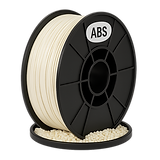
ABS
ABS is suitable for functional parts: robust, impact-resistant, and heat-resistant (~100°C Tg), ideal for tooling, covers, adapters, and small production runs. Printing is more technical (risk of warping, odor), but offers excellent mechanical strength; finishing is possible by sanding/painting or smoothing with acetone vapor. Typical FDM accuracy is ±0.3 mm. For better UV/outdoor resistance, choose ASA. Made-to-Fit options: colors, threaded inserts, assembly; standard lead time 5–10 days or express 2–4 days.

PC
Polycarbonate (PC) is a highly impact-resistant and heat-resistant material (~110–120 °C in operation), ideal for enclosures, protective covers, jigs, and demanding technical parts. Semi-transparent by nature (FDM ≈ translucent), it is rigid and durable, but hygroscopic: reliable printing requires drying and high temperatures (a chamber is recommended). Typical FDM accuracy is ±0.3 mm. Made-to-Fit options include colors/tints, threaded inserts, and sanding/painting; standard lead time is 5–10 days or express 2–4 days.

ASA
ASA is the benchmark for outdoor applications: excellent UV/weather resistance, good thermal stability (~95°C), and strength close to ABS, without significant yellowing. Ideal for covers, enclosures, signage, surveying parts, and small production runs exposed to sunlight. Stable printing (less warping than ABS), typical FDM accuracy ±0.3 mm. Made-to-fit options: colors, threaded inserts, sanding/painting; standard lead time 5–10 days or express 2–4 days.

TPU
TPU is a flexible and abrasion-resistant elastomer, ideal for gaskets, bushings, bumpers, sheaths, anti-slip grips, and shock-absorbing parts. It offers excellent resistance to impact, repeated bending, and many oils and products; typical hardness ranges from 85A to 98A (flexible to semi-rigid). Printing is slower, and drying is recommended (hygroscopic material). Typical FDM accuracy is ±0.3–0.5 mm depending on geometry. Made-to-Fit options include a choice of hardness, colors, and simple finishes; standard lead times are 5–10 days, or express 2–4 days.

PA
PA (polyamide/nylon) is a highly wear-, fatigue-, and impact-resistant material with a low coefficient of friction—perfect for gears, hinges, bushings, slides, flanges, and MRO parts. It withstands heat and repeated stress well while retaining some flexibility (less brittle than ABS/PLA). Being hygroscopic, it must be dried and printed in an enclosure for consistent quality; slight dimensional variation is possible (we compensate for this with DFM). Typical FDM accuracy is ±0.3–0.4 mm.
FDM (fused deposition modeling) 3D printing has become an operational tool for companies that want to prototype quickly, produce in small batches, and repair instead of discarding. It's no longer a gimmick: it's an agile, precise (up to ±0.3 mm depending on the geometry), and cost-effective industrial tool for reducing lead times and costs.

FDM printing
Here are 4 key advantages for a business:
Speed to market — Prototypes and micro-series in days rather than months.
Controlled costs — No tooling/mold, low MOQ, predictable prices (material + time + finish).
Agility & personalization — Rapid Change Management (DFM), A/B variants, custom parts without fixed additional cost.
Speed to market — Prototypes and micro-series in days rather than months.

Print msla
MSLA (UV-cured resin) 3D printing has become a tangible asset for companies looking to produce highly detailed parts, accurate prototypes, and small production runs with a professional finish. It's no longer just a "maker thing": it's a fast, precise (often within ±0.1 to ±0.2 mm depending on the machine, resin, and post-processing) and cost-effective technology for achieving smooth surfaces, tight tolerances, and presentation-ready results.
Here are 4 key advantages for a business:
Ultra-fine details — Letters, textures, small crisp features, even on compact pieces.
Premium finish — Smooth surfaces, fewer layer marks, “showroom” look.
Efficient small batches — Several parts per tray, stable repeatability, short lead times.
Specialty resins — Tough, flexible, high temperature, dental/jewelry as needed.
3D scanning
3D scanning (scanning/measuring a real object to create a digital model) has become an operational lever for companies that want to reproduce parts, accelerate design, and control quality without starting from scratch. It's no longer a gimmick: it's a fast, reliable, and cost-effective industrial tool for capturing complex shapes, reducing errors, and shortening development times.

Here are 4 key advantages for a business:
Rapid parts reproduction — Replace a broken/rare part without a plan or manufacturer.
Accelerated prototyping — 3D base ready to modify, adapt and print faster.
Quality control & inspection — Compare the actual part to the model, detect discrepancies.
Capturing complex shapes — Organic geometries and surfaces that are difficult to measure manually.
Processing process

Our process is intentionally simple: 1) you request a quote, 2) we design or adjust your part in 3D, 3) we start printing/production, and then 4) we package and ship. In four clear steps, you go from idea to delivered part, with delivery times announced from the outset.